Friday, March 11, 2011

Are You There God? It's Me, Margaret.


Blume, J. (1970). Are You There God? It's Me, Margaret. New York, NY: Random House, Inc.

Plot Summary:
Margaret just moved with her parents from her apartment in New York City, her friends and grandmother, to the suburbs of New Jersey. She immediately becomes friends with Nancy, a neighbor her age, who fills Margaret in school gossip and informs her on what is and is not cool at their school. Once the school year begins, Margaret meets the rest of Nancy's crew and becomes a part of their secret club. As part of this club Margaret must wear a bra, which, much to her chagrin, is not something she yet requires. As the school year passes Margaret keeps in touch with her grandmother, who still lives in New York City, continues to hang out with her friends, and begins to explore different religions as part of a year long project for her class. Margaret's father was raised Jewish and her mom, Christian. After her paternal grandmother became upset her son was marrying someone not Jewish and her materal grandparents decided to have nothing to do with their daughter for marrying a Jew, Margaret’s parents decided to raise her without religion. Margaret has always kept the fact that she talks to God a secret from her parents and they get upset when she tells them she has begun exploring different religions, stating she is too young for such a big decision. Margaret navigates through her sixth grade year learning about boys, dealing with her feuding family and lying friends, and anticipating changes in her body that are reluctant to come.

Review:
This is a great book for tweenaged girls. I read it at as a tween and remember it making me feel so NORMAL, which was something I didn't often feel at that age. Margaret is dealing with friends who are more developed than her, friends with insecurities, and her own questions about what she wants and who she is. That is every girl in their tween years. Because this book is especially important for girls about to get their period, I think it’s excellent they revised it to include maxipads with adhesive. I remember loving the book until I read about having to get a belt when I get my period. I had NO idea what Ms. Blume was talking about. I worried about it for a couple of days and then finally asked my mom, who explained that’s how pads used to be. For nostalgic reasons, I was really looking forward to that part, but I am glad they updated it to avoid panic in tween girls the world over.

Genre:
realistic fiction

Reading Level:
Ages 9 - 12

Subjects/Themes:
self-identity, moving, religion, periods, friendships

Character Names/Descriptions:
Margaret Ann Simon: narrates the book; just moved from New York to New Jersey; is in the sixth grade; struggling with her religious beliefs; wants to be normal and get her period
Nancy Wheeler: Margaret's first friend in New Jersey; introduces her to Janie and Gretchen; heads up their secret club; lies to Margaret about a few things
Janie Loomis and Gretchen Potter: friends of Nancy's who become Margaret's friends; together the four girls form the Four PTS's (The Pre-Teen Sensations)
Laura Danker: girl in Margaret's class who is very developed; Nancy has told Margaret lies about Laura
Grandmother (Sylvia): Margaret's paternal grandmother' lives in New York; is Jewish and would like Margaret to also be Jewish; loves Margaret very much, but doesn't get along with Margaret's parents very well
Moose Freed: fourteen year-old friend of Nancy's brother; mows Margaret's lawn; Margaret has a crush on him

Annotation:
Margaret navigates through her sixth grade year learning about boys, religion, dealing with her feuding family and lying friends, and anticipating changes in her body that are reluctant to come.

Book Trailer #1: Chasing Lincoln's Killer

Sunday, March 6, 2011

And Then What Happened Paul Revere?


Fritz, J. (1973). And Then What Happened Paul Revere? New York, NY: Scholastic, Inc.

Summary:
Most people are aware of Paul Revere's famous ride to announce the arrival of the British troops to the colonies during the Revolutionary War. But, do they also know that he took part in the Boston Tea Party or that he made false teeth? This book tells about Revere's historic ride and discusses other aspects of his life as well, including his family, military life, and the many different occupations he held. It seems that Paul Revere did not like to be idle, he kept several jobs, many at the same time. His role with the Sons of Liberty in the Boston Tea Party and his ride to spread news of the event to Philadelphia and New York won him the respect of the Patriots, who made him an express rider and secret agent. The book also provides little known facts as told by his great-grandchildren of his famous ride and details events that took place after his death.

Review:
This is a quick little biography. It is written like a fictional account, helping to keep young readers interested in Paul Revere's eventful life. The author adds in funny little anecdotes about Revere's life, such as his dog returning to his home to fetch the spurs he had forgotten on the night of his great ride, as later told by his granddaughter. Or that he sold false teeth he had whittled out of hippopotamus tusks. Another great addition to the book is the inclusion of actual quotes taken from Revere's own writings and images of the engravings from his metalworking. The illustrations add a humorous quality to the book through the cartoon drawings of his life. They also help to keep the biography interesting and entertaining for the young reader.

Genre:
biography, history

Reading Level:
Ages 8 - 12

Similar Books:

Subjects/Themes:
Paul Revere, Revolutionary War, American history

Annotation:
Paul Revere is well known for his historic ride to alert the colonies of the invasion of the British troops during the Revolutionary War, but not much else is known about him. This book provides additional information about Revere's life before and after his famous ride.

Joey Pigza Swallowed the Key


Gantos, J. (1998). Joey Pigza Swallowed the Key. New York, NY: Farrar, Straus, and Giroux.

Plot Summary:
Joey Pigza's mom and dad ran off when he was a baby and left him to be raised by his emotionally abusive grandmother. After cleaning herself up a bit, Joey's mom returns to take care of him. Joey has Attention Deficit Hyperactivity Disorder (ADHD). His grandmother didn't believe there was anything medically wrong with him and the medicine he's been taking since his mom arrived isn't working. Joey has good days and bad days and usually can't sit still after lunch. Joey's school has a hard time with him and doesn't have the resources to provide the care he needs. After his repeated outbursts in class that often not only injure himself, but his classmates as well, Joey is ordered to go to a Special Education school. Once at this special school, Joey is taught more about his disorder and given tests and has x-rays taken of his brain. His doctors put him on a new drug that seems to help with his hyperactivity. Joey is able to return to his regular school and realizes that he is a good kid after all, he just has some medical issues that need attended to.

Review:
The author of this book does an incredible job putting the reader in the mind of a child with Attention Deficit Hyperactivity Disorder. This book was really uncomfortable for me to read at times because of the unfortunate circumstances of Joey's family life and his struggle with trying to be good. Joey is extremely likable and the author succeeds in getting the reader to see his internal struggle with wanting to do right, but his mind and body not allowing him. I think that this would be a great book for teachers, parents, and maybe even children with ADD, but I wouldn't have imagined that many children would be interested or really understand Joey's struggle. But, I suppose the author included enough silliness of Joey's character to have wide appeal and I know it is a very well liked book by kids. Joey is a funny guy and says a lot of funny things such as his token response to any question, "can I get back to you on that?"

Genre:
realistic fiction

Reading Level:
Ages 9 - 12

Subjects/Themes:
Attention Deficit Hyperactivity Disorder, single-parent, alcoholic, emotional abuse

Awards:
ALA Notable Children's Book
California Young Reader Medal
National Book Award Finalist

Series Information:
First book in Joey Pigza series:
Joey Pigza Swallowed the Key
Joey Pigza Loses Control
What Would Joey Do?
I am Not Joey Pigza


Character Names/Descriptions:
Joey Pigza: raised by his emotionally abusive grandmother; mother is an alcoholic; has Attention Deficit Hyperactivity Disorder
grandmother: Joey's paternal grandmother; raises Joey until his mom returns; she is emotionally abusive to Joey, she leaves when Joey's mom returns
mom: Joey's mom; she returns to raise Joey after being gone most of his life; she is an alcoholic; she is finally trying to help Joey and get him the medicine and attention he needs
Mrs. Maxey: Joey's teacher at his regular school; tries to help Joey but is concerned that he is going to hurt himself or other students
Maria Dombrowski: good student in Joey's class; Joey accidentally cuts off the tip of her nose
Ed Vanness (Special Ed): Joey's caseworker at the special education school

Annotation:
Joey tries to be good and sit still like he's asked, but his Attention Deficit Hyperactivity Disorder prevents him from doing so. When he's moved to a special school and given more attention from his mom, case worker, and teachers, Joey begins making progress along with a medication that hopefully will help.

Saturday, March 5, 2011

The Graveyard Book


Gaiman, N. (2008). The Graveyard Book. New York, NY: HarperCollins Publishers.

Plot Summary:
During the tragic demise of his parents and sister at the hands of a knife-wielding man, a toddler wanders out of his home while the whole ordeal is taking place and up the street to the nearby graveyard. This is very unfortunate for the murderer , whose order was to kill the entire family. The murderer follows the scent of the boy to the graveyard where the baby's mother's spirit appeals to a ghost woman and begs her to take care of her son. The ghosts in the graveyard protect the baby from the murderer and vow to raise him as their own, giving him the Freedom of the Graveyard. The Owens, the ghosts who act as his parents, name the boy Nobody Owens, calling him Bod for short. Bod is raised by ghosts in the graveyard, learning the tricks of the ghosts, and rarely leaving to walk among the living. He learns how to read and write from ghosts who were teachers when they were alive, learns the ways of the dead from a werewolf, and about the fickleness of girls from a witch. Unfortunately, the secret society who ordered Bod's family murdered has not forgotten about the boy and returns to finish the job. It is up to Bod all he has learned to protect himself from these evil men.

Review:
This is such a well crafted story, so rich with imagination. Using the graveyard as an unlikely setting of a boy's upbringing is unique and pleasantly spooky. It is a wonderfully bizarre and unusual coming of age story, not unlike the author's inspiration, The Jungle Book. Gaiman develops his characters well, and provides lovely descriptions of the graveyard. There are many little details that add to the fun of this book, such as the inscriptions of each tombstone being provided after the introduction of each new ghost into the story. I thought that was a very clever touch. I was much more interested in Bod's life in the graveyard and learning about each of the ghosts and what they did in life and what they taught Bod, rather than the plot itself. The plot was great, but I was content with reading all of the little vignettes about Bod's time in the graveyard. The dark and misty quality of the illustrations add to the spookiness of the story.

Genre:
fantasy, horror

Reading Level:
Ages 9 - 12

Similar Books:

Awards:
2009 Newbery Medal Award
2009 Hugo Award
2010 Carnegie Medal
Locus Award

Subjects/Themes:
family, friends, loss, death, self-identity

Character Names/Descriptions:
Nobody Owens (Bod): family is killed when he is a baby; raised by the ghosts in the graveyard and given the Freedom of the Graveyard; lives in the graveyard until he is fifteen years-old; a secret society is trying to murder him
Silas: Bod's guardian; he is able to walk among the dead and the living so he can bring food and things from outside the graveyard to Bod; member of the Honour Guard
The Owens: ghost husband and wife who adopt Bod and raise him as their son
Scarlett: young living girl who plays with Bod in the cemetery when she was young and then makes his acquaintance again when they are older; befriends Mr. Frost; introduces Bod to Mr. Frost
Liza Hempstock: witch living in the graveyard; helps Bod with his fading; can leave the graveyard because she is buried just outside of it in unconsecrated ground
Nick Farthing and Maureen Quilling (Mo): living kids in Bod's town; bullies at the school Bod briefly attends; Bod haunts them
Jack Frost: murdered Bod's family; disguises himself as a historian; part of the secret society, the brotherhood of the Jacks of All Trades

Annotation:
A boy is raised by a graveyard after his family is murdered. The graveyard comes together to protect the boy from the evil that is still after him.

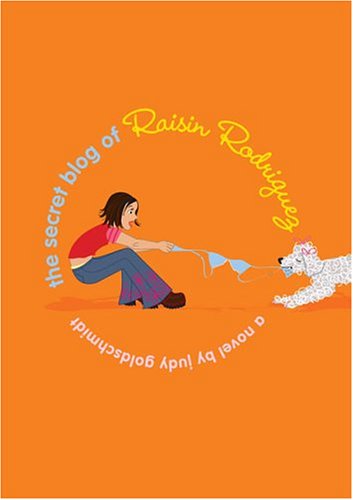
The Secret Blog of Raisin Rodriguez


Goldschmidt, J. (2005). The Secret Blog of Raisin Rodriguez. New York, NY: Penguin Group.

Plot Summary:
Raisin Rodriguez is not having the best year of her life. She was happily living in Berkeley, CA with her mom and dad and little sister, when her parents decided get a divorce. Then, her mom falls in love and gets married to her business partner. Next thing Raisin knows she's moving all the way to Philadelphia to live with her new stepdad and stepsister. Raisin is miserable in her new town, she misses her two best friends, doesn't like her older stepsister, and only knows one person at school, a freckle-face son of a friend of her stepdad's. In an effort to keep in touch with her best friends Raisin begins a blog where she discusses every single detail of her life in Philadelphia, including the all the tragic details of her trying to become friends with the popular girls of her school. Just when things start looking up for Raisin, her blog gets leaked to the rest of the school, how will she be able to face all of her schoolmates once they know all the awful things she's said about them and embarrassing things she's admitted about herself?

Review:
This book is like the Bridget Jone's Diary for tweens. At times the book can be over the top with silly antics and funny scenarios, and yet Raisin is a girl dealing with real issues, common to girls her age. Raisin's parents just went through a divorce, she had to move across the country to live with a new family and leave behind all of her friends. She is having self-identity issues at the new school, wanting so badly to be popular, but not quite achieving that status. I felt that the narrator's silly and at times annoying antics were too much and covered up a lot of the real issues involved in the plot and she can be a bit of a bully. But, the book's intent was obviously meant to be more entertaining, with a bit of a moral thrown in. In the end it seems Raisin has turned over a new leaf, yet she continues to write negative things about her new friends on her blog.

Genre:
realistic fiction

Reading Level:
Ages 10 - 13

Similar Books:

Subjects/Themes:
diary, divorce, popularity, self-identity, friendship

Character Names/Descriptions:
Raisin Rodriguez: 12 year-old girl; just moved from Berkeley, CA to Philadelphia after her parents divorced and her mother remarried; has only one friend at her new school; longs to be popular; keeps a blog
Claudia and Pia: Raisin's best friends from Berkeley; are the only ones privy to reading her blog; make comments on the blog
Jeremy Craine: son of Raisin's stepdad's friend; only person Raisin knows at school; talks too loud; has freckles; is really nice to Raisin, even if she isn't always nice back; likes Fiona
Fionas and Haileys: group of popular girls named the "Fiona and Haleys" by Raisin consisting of Fiona, Hailey, Madison, and Bliss; all carry a red bag with pink monogrammed initials; do not want Raisin in their clique

Annotation:
Outcast and alone at a new school, Raisin writes a blog in an effort to keep in touch with her best friends now on the other side of the country. But once the blog leaks out to her new school, all the work Raisin has done to gain popularity is in jeopardy of being ruined.

Tuesday, March 1, 2011

Professional Reading #4

Stout, H. (2010, April 30). Antisocial Networking? The New York Times. Retrieved from: http://www.nytimes.com/2010/05/02/fashion/02BEST.html

Teens and tweens using social networking sites and texting gets a lot of negative attention primarily because of publicized instances of cyberbullying and sexting. This article takes on a whole other issue with this trend, how are these modes of communication affecting young people's social interactions with one another. Children are able to communicate with one another more than ever and have several different ways in which to do so. But has this begun to diminish the actual face-to-face communication between friends and are quality friendships deteriorating because of this phenomenon?

I see it as a quality versus quantity issue. Face-to-face communication yields a depth and understanding among friends that is hard to achieve through a computer or mobile device. But, the ability to communicate with friends constantly throughout the day provides young people with more opportunities to interact with their friends. Parents in the article were split on the issue. One stated that by using Facebook her son is satisfied with that as his primary social interaction with his friends; he is reluctant to hang out with them in person. Another parent stated that Facebook has enabled his shy son the ability to communicate more confidently with his peers, it has helped to bring him out of his shell.

I think that outgoing young people are going to hang out with their friends no matter what. To them, texting or Facebook is just a way to keep up with friends when they're not together. I think that the problem would be with those who are more reserved, where they are satisfied with primarily interacting with their friends through their mobile devices. It is disconcerting to think that this type of communication will affect young people's social interactions and quality of friendships now and as they become adults.