Saturday, April 30, 2011

Sex, Puberty and All That Stuff: A Guide to Growing Up


Bailey, J. (2004). Sex, Puberty and All That Stuff: A Guide to Growing Up. London: Franklin Watts.

Summary:
This book covers a lot of information on sex and puberty for boys and girls. It discusses all of the topics typical to books like this, such as sex organs and genitals, acne, birth control, pregnancy, peer pressure, and dating. It also discusses topics which other books might not tackle, such as penis size, lopsided breasts, homosexuality, and masturbation. Nicknames or slang terms are also included for genitals and sex organs. Questions such as, "Is it true you can't buy condoms until you're 16?" or whether you "can't use a tampon if you're a virgin" are explained in the book. The back of the book contains contact information for various services such as Advocates for Youth, adoption agencies, pro-choice resources, and gay and lesbian services. The images and diagrams in the book are all cartoons. There is a glossary at the back of the book, which defines all of the terms covered within the book.

Review:
It's been awhile since I've read a book on sex and puberty intended for young people, and boy is this one different than the one I had. At times I was almost shocked by some of the things included in this book, such as the slang terms for genitals. But then I realized that there are some young people who may of only heard of these body parts in slang terms and it is important for them to know their technical names. I felt like this book was more conversational and less clinical than the book I had when I was younger. I think that aspect of it will appeal to tweens. I also like that it is intended for both boys and girls. This book is very forward thinking, it included questions or facts that tweens might be curious about that they may learn about from friends or older siblings, but too embarrassed to ask. I think that this book would be a little mature for younger tweens, even though puberty can begin in young tweens.

Genre:
nonfiction

Reading Level:
Ages 10 - 15

Subjects/Themes:
puberty, sex

Annotation:
This book contains many of the sex and puberty questions you have, but are too embarrassed to ask.

A Wolf at the Door and Other Retold Fairy Tales


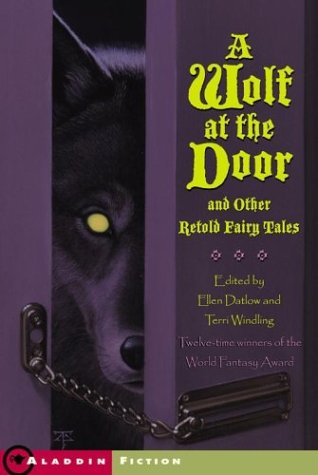
Datlow, E. & Windling, T. (eds). (2000). A Wolf at the Door and Other Retold Fairy Tales. New York, NY: Simon & Schuster Books for Young Readers.

Summary:
Some of the world's most favorite fairy tales are retold in this collection of stories by various popular authors. Award winning authors like Neil Gaiman and Gregory Maguire create new stories out of old fairy tales. In the retelling of Hansel and Gretel, instead of a gingerbread house, the witch lures them in with video games and in the retelling of Cinderella, she wears a slipper made of twigs, not glass. Some of these classic fairy tales are retold from a modern perspective, and some are told from an entirely different perspective, such as Jack and the Beanstalk as told by Mrs. Giant or Snow White being discussed from the dwarfs' perspective after she has left with the prince.

Review:
I really loved reading Wicked: The Life and Times of the Wicked Witch of the West by Gregory Maguire. Many of the fairy tales in this collection are like that, but meant for tweens. Gregory Maguire even contributes a tale about Snow White to the book. I was immediately drawn into the stories, reminding me that no one is ever too old for a good fairy tale. It does add interest to have a new spin on them. Some of the tales are a little edgier or more modern, which will definitely appeal to some tweens, others keep the original tone of the old fairy tales, but add new elements to them. I especially loved the retelling of the Twelve Dancing Princesses. It was beautiful and eerie, it made me want to read the original to see how much was kept in this new version. I think these stories might have the same effect on the tweens who read them.

Genre:
nonfiction

Reading Level:
Ages 8 - 17

Subjects/Themes:
fairy tales

Annotation:
A compilation of retold fairy tales by award winning fantasy authors.

In the Year of the Boar and Jackie Robinson


Lord, B.B. (1984). In the Year of the Boar and Jackie Robinson. New York, NY: Harper Row & Publishers, Inc.

Plot Summary:
The book is set in the year 1947. After hearing word from her father in America, Bandit and her mother must leave their family in China and travel to New York to join him. Upon leaving Chungking, her family gives her an American name of her choosing; she becomes Shirley Temple Wong. Shirley and her mother finally arrive to their tiny one room apartment in Brooklyn after a long journey. Shirley begins school and her mother adjusts to life without servants and with washing machines. It takes Shirley a few months to adjust to life, customs, and the English language. She is lonely at first, without any friends. She accidentally interrupts a stickball game one day after school and receives two black eyes from a bully named Mabel. After not squealing on Mabel, the stickball players befriend Shirley and teach her the game. Shirley takes to it immediately, becoming obsessed with baseball, specifically the Brooklyn Dodgers and Jackie Robinson. For the rest of the season, she doesn’t stray far from the radio when a game is being played. By the end of the year of the boar, Shirley has adjusted well to life in Brooklyn, but also realized the importance of maintaining her original language and customs.

Review:
I love the organization of this book, spread over a year, beginning in China. The author shows the progression of Shirley’s year of transformation from being well versed in Chinese customs, to struggling with English and American customs, to submersing herself in only American customs, and finally finding a balance between her Chinese culture and new life in America. I love that the main character is a girl, who is obsessed with baseball. Shirley’s obsession with the sport is fantastic; it adds a lot of humor to the book. There is a great explanation of why baseball is an America’s favorite pastime and there is a lot of symbolism in Shirley’s embracing of this. I like that the events in the book were drawn from the author’s own life and coming to America. Through Shirley’s experiences she shows the hardships and loneliness of children coming to a new country and learning a new language and all new customs.

Genre:
historical fiction

Reading Level:
Ages 9 – 12

Subjects/Themes:
immigration, self-identity

Award Information:
ALA Notable Children's Book
School Library Journal Best Book

Character Names/Descriptions:
Shirley Temple Wong (Bandit, Sixth Cousin): 10 years old; travels from China to New York with her mother to join her father; loves baseball and Jackie Robinson
Father: Shirley’s father; gets an Engineering job in New York and moves his wife and daughter from China to join him; takes on the job of landlord of their building
Mother: Shirley’s mother; moves from China to New York with her daughter, Shirley, to join her husband; becomes pregnant
Mabel: largest 5th grade girl in Shirley’s class; gives Shirley two black eyes, then becomes her friend; plays stickball; teaches Shirley all about baseball
Mrs. Rappaport: Shirley’s 5th grade teacher
Emily Levy: new girl in Shirley’s class; becomes one of Shirley’s good friends
Jackie Robinson: baseball player for the Brooklyn Dodgers; hero of Shirley’s

Annotation:
It is 1947, the year of the boar, and the year Shirley Temple Wong leaves her home in China and moves to Brooklyn, New York. Shirley learns English and American customs, falls in love with baseball, and tries to hold on to her Chinese heritage.

The 39 Clues: The Maze of Bones


Riordan, R. (2008). The 39 Clues: The Maze of Bones. New York, NY: Scholastic, Inc.

Plot Summary:
Amy and Dan Cahill’s parents died long ago, they were left in the care of their great aunt, but loved dearly by the Grandmother, Grace Cahill. When Grace Cahill dies, an incredibly wealthy woman, family members from far and wide come to attend her wedding and to find what they have inherited. Through a video shown by her lawyer, Grace tells the family members that they can either take a million dollars each, or forfeit the money to participate in a challenge, which could make them extremely powerful. Amy and Dan choose to take the challenge along with a few other family members. They are informed that the Cahills are a very powerful family, producing the likes of Benjamin Franklin and Abraham Lincoln. Each participant is given a clue they must solve, the first of 39. The clue initially stumps the two, but with a little encouragement from their grandmother’s lawyer, they are off and running. The challenge has Amy and Dan traveling all over with their sassy au pair and narrowly escaping traps set against them by their own competing family members.

Review:
This was an exciting book, reminding me at times a little of The Westing Game and a little of The Da Vinci Code. I could see kids really getting into these books, especially because of the size of the series. After beginning the book and realizing, there was not really going to be an end to the book and only one clue would be solved, I was a little annoyed thinking I would have to read 38 more books to discover the final outcome of the series, but it looks like there are only 11 total in the first series. I have heard this series described as a marketing ploy, which is hard not to see with game instructions on the back of the book for kids to play. The whole back cover of the book is an advertisement for the 39 Clues game kids can play by collecting playing cards (which come with the book) and entering to win over $100,000 in prizes. This irked me. I would rather kids be interested in books because they enjoy them, not because there is a prize involved. It was a fun and quick book to read, I think they could have done without the gimmick.

Genre:
fiction, mystery, adventure

Reading Level:
Ages 9 – 14

Subjects/Themes:
loss, siblings, treasure hunt

Series Information:
first book of the first series

Character Names/Descriptions:
Amy Cahill: 14 years old; sister to Dan; parents mysteriously died when she was young; her grandmother died leaving a challenge for Amy and Dan and other family members to take; part of a very powerful family; likes to read; has a stutter
Dan Cahill: 11 years old; brother to Amy; parents mysteriously died when she was young; her grandmother died leaving a challenge for Amy and Dan and other family members to take; part of a very powerful family; likes numbers; has a great memory
Grace Cahill: grandmother to Amy and Dan; very wealthy and powerful woman; in her will she challenged her family members to take part in a game that could make them very powerful; has a cat named Saladin
William McIntyre: Grace Cahill’s lawyer; helps Amy and Dan with the challenge
Ian and Natalie Kabra: cousins of Dan and Amy; also take part in the challenge; are evil
The Holt family: relatives to Dan and Amy; also take part in the challenge; are all athletic; aren’t afraid to use brut force to stop their cousins
Alistair Oh: relative of Dan and Amy; Korean; takes part in the challenge; tries to form an alliance with Dan and Amy, but eventually betrays them
Irina Spasky: relative of Dan and Amy; Russian; former spy; takes part in the challenge; uses sneaky methods to try to stop the other participants of the game

Annotation:
Upon the death of the grandmother, Dan and Amy Cahill are invited to participate in a game where they could become very powerful.

Out of the Dust


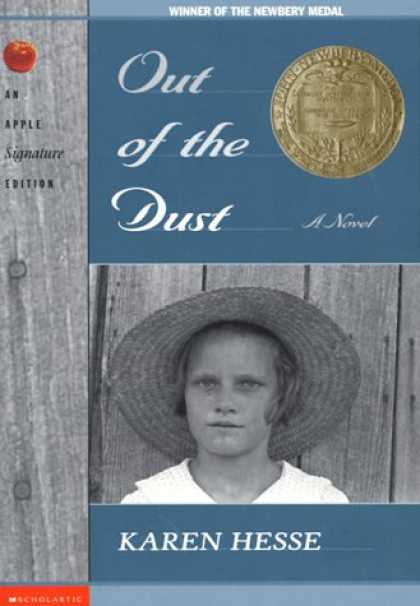
Hesse, K. (1997). Out of the Dust. New York, NY: Scholastic, Inc.

Plot Summary:
Billie Jo lives with her mom and dad in the panhandle of Oklahoma. The book begins in the winter of 1934, Billie Jo is 14 years old and after years of trying, her mother is finally pregnant again. Her family struggles to survive in the dust bowl where dust storms are ruining her father’s wheat crops. It is her mother’s piano and Billie Jo’s crazy style of playing which bring her the most joy in life. An accident of a pail of kerosene set by the fire by her father, mistaken to be water by her mother and thrown on the fire, and then hurriedly tossed outside by Billie Jo dousing her mother with it instead, turn the Kelby family’s life upside down. Her mother, covered in burns dies in childbirth, taking Billie Jo’s baby brother with her. Billie Jo’s hands were severely burned and she can no longer play the piano. Her relationship with her father is strained, each dealing with their own guilt and blame for the accident. Billie Jo, predicting the way her unhappy life is going in Oklahoma, hops a train west, only to be returned home by a government agency in Arizona. Her running away begins Billie Jo and her father communicating and begins to mend their little family.

Review:
The style in which this book was written was uniquely beautiful. It was a devastating book, with a glimmer of hope at the end, which I’ve found is similar most award winning tween books. I loved the setting for the book, having never read a book set in the dust bowl. The book provided a glimpse of the hard life people who lived in the dust bowl during the depression had to face. Billie Jo is a likable character, spunky and non-conforming to girls her age at that time. I loved reading about her crazy piano playing and was crushed when she could play no longer. As mentioned earlier, this is a really devastating book, but it shows how family is able to overcome incredibly difficult obstacles.

Genre:
historical fiction

Reading Level:
Ages 9 – 14

Subjects/Themes:
dust bowl, loss

Awards:
Newbery Medal Award Winner
ALA Best Book for Young Adults
A Publishers Weekly Book of the Year

Character Names/Descriptions:
Billie Jo Kelby: 14 year-old girl; lives in the panhandle of Oklahoma with her pregnant mom and dad; loves to play the piano; accidently burned her mother
Pol Kelby (Ma): Billie Jo’s mom; pregnant; died in childbirth after being burned over most of her body; played the piano
Bayard Kelby (Daddy): Billie Jo’s dad; a farmer
Arley Wanderdale: teaches music at Billie Jo’s school; invites her to play with he and his band at the Palace Theatre
Mad Dog Craddock: friend of Billie Jo’s; has a great voice; sings in the same shows where she plays the piano; she has a crush on him

Annotation:
Life in the dust bowl during the depression was hard, but after a terrible accident in her family, life becomes almost unbearable for Billie Jo Kelby.

Sunday, April 24, 2011

Book Trailer #2: Belle Prater's Boy

The Spiderwick Chronicles: Book 1, The Field Guide


DiTerlizzi, T. & Black, H. The Spiderwick Chronicles: Book 1, The Field Guide. New York, NY: Simon & Schuster Books for Young Readers.

Plot Summary:
After their parent's recent divorce the Grace children, Mallory, Jared, and Simon, all move with their mom from their apartment in New York to a decrepit Victorian house belonging to their great-aunt, Lucinda. The Grace children immediately sense that there is more to this house than they can see. The scratching noise in the walls prompt them to break open part of the wall where they find an interesting little nest full of newspaper clippings and cockroaches strung up on a string. Mallory destroys the nest, thinking whatever it was that was making it will have to leave. But, destroying its home only makes this little creature angry and strikes vengeance on the Grace children. A note Jared finds in a secret room in the house leads him to discover Arthur Spiderwick's Field Guide to the Fantastical World Around You and the children learn that there is a lot more to this house and their world than they had ever realized.

Review:
This is a wonderfully imaginative book. It is rather short and a quick read, good for younger tweens. Plus, it's a series that leaves the reader with a great hook at the end of the first book, which will inspire young readers to pick up the next book in the series. The illustrations are awesome and add a lot to the book. The Grace children each have their own unique interests, and bond together in their quest to discover what is scurrying around in their house. The authors show the struggle of kids from a recently divorced family, as they are forced to leave the comfort of their home and make major changes in their lives. I look forward to reading more of the Grace children's adventures.

Genre:
fantasy

Reading Level:
Ages 7 - 12

Subjects/Themes:
divorce, siblings, faeries
Series Information:
Book 1 of The Spiderwick Chronicles

Character Names/Descriptions:
Jared Grace: 9 years-old; twins with Simon; brother to Mallory; parents recently divorce; he is having some trouble with his parent's divorce; he finds the Field Guide
Simon Grace: 9 years-old; twins with Jared; brother to Mallory; obsessed with animals; has creatures in jars all over the room he shares with Jared
Mallory Grace: 13 years-old; sister to Simon and Jared; loves fencing; destroys the nest in the wall; has her hair tied to her bed while she sleeps
Arthur Spiderwick: the father to Lucinda, the Grace children's great-aunt; made the Field Guide to the Fantastical World Around You Jared finds
Lucinda Spiderwick: the Grace children's great-aunt; is in a home after going crazy talking about faeries; the Grace children go to live in her old Victorian home

Annotation:
After moving to a old Victorian home, the Grace children begin to feel that they are not alone in their new home. The discovery of a peculiar nest in the wall and an interesting book open their eyes to things beyond their imagination.